

























By Kevin Leoncio, Account Representative, Essential Cares Supplies, Inc.
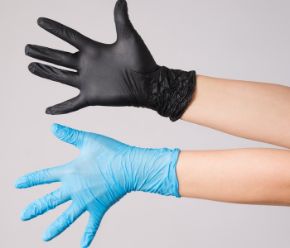
Nitrile, natural rubber latex and vinyl (PVC) are the three materials most institutional buyers see on an exam glove quote. Each has its own ASTM specification, its own labeling considerations and its own place in a facility's item master. This article compares them from a purchasing angle: what the standards cover, how latex status works as a buying attribute, why powder-free is now the baseline, and when organizations choose to standardize on one material.
It does not make clinical recommendations or claim that one material performs better than another. Performance differences depend on the specific product and the tests behind it, so ask each manufacturer for data on the item you intend to buy.
Three materials, three standards
ASTM International publishes a separate public specification for each glove material. The titles and scopes below come from ASTM's own listing pages.
| Attribute | Nitrile | Natural rubber latex | Vinyl (PVC) |
|---|---|---|---|
| ASTM specification | D6319, Standard Specification for Nitrile Examination Gloves for Medical Application | D3578, Standard Specification for Rubber Examination Gloves | D5250, Standard Specification for Poly(vinyl chloride) Gloves for Medical Application |
| What the spec says it covers | Nitrile rubber gloves for medical examinations and diagnostic and therapeutic procedures; items include freedom from holes, physical requirements before and after ageing, powder amount, tensile strength and ultimate elongation | Natural rubber gloves for medical examinations and diagnostic and therapeutic procedures; scope summary also lists sterility, dimensions, tensile strength and protein content | PVC gloves for medical examinations and diagnostic and therapeutic procedures; items include freedom from defects, physical properties before and after aging, powder content, tensile strength and elongation |
| Natural rubber latex labeling | Not a natural rubber latex product | FDA guidance calls for a bold caution that the product contains natural rubber latex which may cause allergic reactions | Not a natural rubber latex product |
| Referenced in FDA's glove guidance | Yes | Yes | Yes |
| Documentation to request | 510(k) number, D6319 test report, spec sheet | 510(k) number, D3578 test report, protein and powder data, spec sheet | 510(k) number, D5250 test report, spec sheet |
FDA's Medical Glove Guidance Manual lists D3578, D5250 and D6319 together as the ASTM specifications for patient examination gloves, and recommends confirming that gloves meet the current requirements of the applicable one. Whether a given product actually does is a documentation question; see Medical Exam Gloves vs. Industrial Nitrile Gloves for what to request.
Latex status as a purchasing attribute
For a buyer, "latex or non-latex" works like any other item-master field: it needs to be accurate, searchable and consistent across departments. The facts that matter operationally are these:
- The FDA requires manufacturers to identify the materials used to make medical gloves on the package labeling, and the FDA's glove page names PVC, nitrile and polyurethane as alternatives for people who are allergic to latex.
- OSHA's latex allergy guidance cautions not to assume that hypoallergenic, glove-liner or powderless gloves are non-latex or latex free. "Powder-free" and "latex-free" are different attributes and need separate fields.
- OSHA also notes that employers under the Bloodborne Pathogens Standard must make alternatives such as hypoallergenic gloves, liners or powderless gloves readily accessible, and describes synthetic, low-protein and powder-free gloves as among the alternatives. NIOSH's alert describes synthetic rubber products as not releasing the proteins that cause latex allergic reactions.
- Whether a facility stocks natural rubber latex gloves at all is a policy decision made by that facility's clinical, safety and infection prevention leadership. Purchasing's job is to carry out the policy and keep the data clean.
Practically, that means recording the material from the label, not from the product name, and treating any substitution across materials as a specification change that needs sign-off, not a routine swap.
Powder-free is the baseline
On December 19, 2016, the FDA published a final rule banning three devices: powdered surgeon's gloves, powdered patient examination gloves and absorbable powder for lubricating a surgeon's glove. The rule took effect on January 18, 2017. Non-powdered gloves were not banned.
The FDA's glove guidance describes gloves with 2 mg or less of residual powder per glove as commonly referred to as "powder free." For buyers, the practical result is that powder-free is the standard attribute on exam gloves of all three materials, and a quote that lists a powdered exam glove should prompt a question about what exactly is being offered.
What buyers compare besides material
| Factor | What to check | Why it matters in purchasing |
|---|---|---|
| Documentation | 510(k) number and the ASTM test report that matches the material | Different material, different standard; one report does not cover another |
| Latex status | Material stated on the label; separate field from powder status | Keeps item master and unit stocking accurate |
| Powder status | Stated powder-free on label and spec sheet | Avoids accepting a product outside your specification |
| Sizes | Which sizes the manufacturer offers and how each is quoted | Each size is typically a separate item number with its own count and price |
| Count per box and boxes per case | Do not assume 100 per box across all sizes | Pack counts vary even within one line; see Nitrile Glove Case Pack Cost Comparison |
| Thickness and fit | Manufacturer data for the specific item | Stated differently across listings; see Nitrile Glove Thickness Guide for how to read it |
| Color and texture | Fingertip texture, color | Matters for unit preference and for telling gloves apart on a shelf, not for exam status |
When organizations standardize on one material
Many multi-site buyers choose a single exam glove material for a facility, a system or a contract. The reasons are administrative rather than technical:
- Fewer item numbers to count, reorder and reconcile across units.
- A single latex-status decision applied consistently, instead of case-by-case exceptions.
- Simpler training, par-level setting and shelf labeling.
- Larger quantities of one specification when negotiating, which can make quotes easier to compare.
- Cleaner substitution rules: when an item is unavailable, the fallback is already documented.
Standardization has a cost as well. A facility that standardizes on one material needs a documented process for departments with a different requirement, and a plan for what happens if that one item becomes unavailable. Skilled nursing facilities, which run many recurring disposables through a small number of storerooms, often feel this tradeoff most; see Skilled Nursing Facility Disposable Supply Purchasing for how par and case planning fit in.
Common mistakes
- Assuming "powder-free" means "latex-free."
- Entering the glove name in the item master instead of the labeled material.
- Comparing per-glove prices across materials without checking that documentation and specifications match.
- Accepting a different material as a substitute without a documented change to the specification.
- Ordering by case without confirming the count per box for each size.
Questions to ask a glove supplier
- What is the labeled material, and does the label carry any natural rubber latex caution?
- What is the 510(k) number, and which ASTM specification does the manufacturer test this item to?
- Is the glove powder-free? How does the manufacturer state residual powder?
- What are the count per box, boxes per case and gloves per case for each size?
- If the item is unavailable, what material and specification is offered instead, and is that a functional alternative, a potential substitute or a different product against my specification?
Essential Cares exam glove listings
Essential Cares carries nitrile, latex and vinyl powder-free exam gloves in the Exam Glove subcategory. Several listings use a 100 per box, 10 boxes per case configuration, for example Splash light blue nitrile, medium, powder-free latex, medium and powder-free vinyl, medium. Not every size follows the pattern: the black nitrile Skintx X-Large and the latex Skintx X-Large list 90 per box. The listings do not state an ASTM or FDA clearance claim, so request documentation for the specific item. Setting-specific listings are also available, such as hospital gloves and correctional facility gloves.
For background on the nitrile standard, see ASTM D6319 Nitrile Gloves: Medical Exam Glove Standards Explained.
Related ECSI Resources
ASTM D6319 explained for procurement
Nitrile glove thickness guide
Medical exam gloves vs. industrial nitrile gloves
Skilled nursing facility disposable supply purchasing
Comparing materials for your next glove bid?
Send Essential Cares the current manufacturer number, specification and quantity, and the team can review available sourcing options. List material, powder status, sizes and the documentation you require.
Browse exam gloves Contact Essential CaresFrequently Asked Questions
Is powder-free the same as latex-free?
No. OSHA specifically warns not to assume that powderless or hypoallergenic gloves are latex free. Record both attributes separately.
Can we switch from latex to nitrile without a specification change?
No. A change of material is a different product against your specification and a different ASTM standard. Route it through your normal approval process.
Do all three materials have a standard?
Yes. ASTM D6319 covers nitrile, D3578 covers rubber (natural rubber) and D5250 covers PVC examination gloves. Whether a specific product conforms needs to be documented by the manufacturer.
Sources
- U.S. FDA, Medical Gloves (materials labeling; latex alternatives; powdered glove ban)
- FDA, Medical Glove Guidance Manual (ASTM D3578, D5250, D6319; natural rubber latex caution; powder-free)
- Federal Register, Banned Devices; Powdered Surgeon's Gloves, Powdered Patient Examination Gloves, and Absorbable Powder for Lubricating a Surgeon's Glove (Dec. 19, 2016)
- ASTM D6319-19, Nitrile Examination Gloves for Medical Application
- ASTM D3578-19, Rubber Examination Gloves
- ASTM D5250-19, Poly(vinyl chloride) Gloves for Medical Application
- OSHA eTool, Hospitals: Latex Allergy
- CDC/NIOSH, Preventing Allergic Reactions to Natural Rubber Latex in the Workplace
Kevin Leoncio is an Account Representative at Essential Cares Supplies, Inc., supporting healthcare, government, and institutional customers with sourcing, product equivalency, procurement, and supply solutions.
 213-743-1401